Introduction
Efficient warehouse storage is essential for businesses that manage large quantities of inventory. As product volumes increase, warehouses need organized storage systems that make better use of available space while allowing employees to access products easily.
Pallet racking systems are widely used in warehouses, distribution centers, and manufacturing facilities to store palletized goods. They help businesses organize inventory vertically, improve accessibility, and create structured storage areas.
However, choosing the right pallet racking system requires careful planning. Different warehouses have different storage requirements depending on product dimensions, inventory movement, available floor space, and material handling equipment.
In this article, we will explore different types of pallet racking systems, their benefits, and important factors to consider when selecting a suitable storage solution for your warehouse.
What Are Pallet Racking Systems?
Pallet racking systems are storage structures designed to hold products placed on pallets. They typically consist of upright frames and horizontal beams that create multiple storage levels.
These systems allow warehouses to use vertical space instead of depending entirely on floor-level storage.
Different Types of Pallet Racking Systems
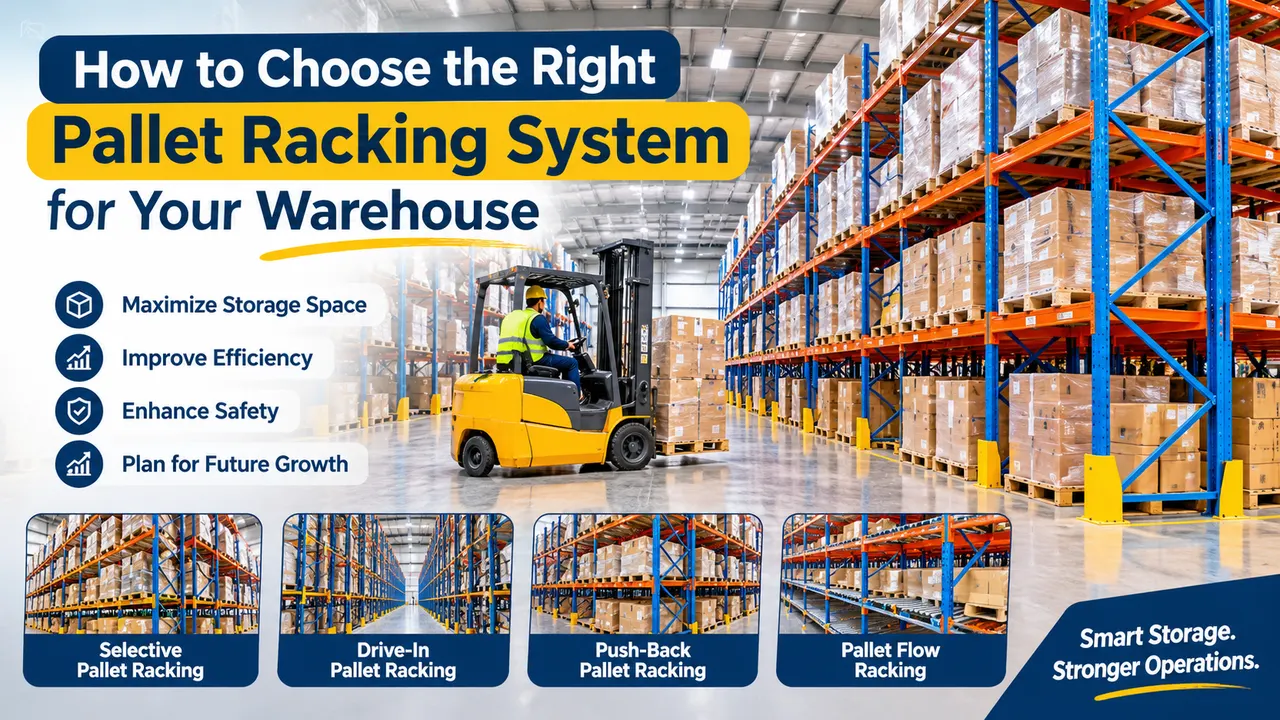
Not every warehouse requires the same storage configuration. Understanding the available options can help businesses select a system that matches their inventory and operational needs.
- Selective Pallet Racking
Selective pallet racking is one of the most commonly used warehouse storage systems. It provides direct access to individual pallet locations.
This system is suitable for warehouses that handle different products and require frequent inventory access.
Key benefits:
Direct access to individual pallets.
Flexible storage arrangements.
Suitable for different product types.
Compatible with common forklift operations.
- Drive-In Pallet Racking
Drive-in racking is designed to store multiple pallets in depth. Forklifts enter the storage lanes to place or retrieve pallets.
It is often considered for businesses that store large quantities of similar products.
Key benefits:
High-density storage potential.
Better use of available floor space.
Suitable for bulk inventory.
Useful for operations with fewer product variations.
- Push-Back Pallet Racking
Push-back racking uses inclined rails and movable carts to store pallets several positions deep.
When a new pallet is loaded, it pushes the previously stored pallet backward. During retrieval, the next pallet moves forward.
Key benefits:
Increased storage density.
Reduced number of access aisles compared with selective layouts.
Suitable for storing multiple pallets of similar products.
Supports organized inventory movement.
Benefits of Installing the Right Pallet Racking System
- Better Use of Vertical Space
Pallet racking allows businesses to store products at multiple levels. This can help make better use of available warehouse height, subject to building conditions and structural requirements.
- Improved Inventory Organization
Clearly defined pallet locations make it easier to arrange products and maintain an organized warehouse.
- Easier Product Accessibility
Depending on the selected configuration, employees can retrieve products more systematically and reduce unnecessary movement.
- Support for Warehouse Operations
A suitable racking layout can help organize receiving, storage, picking, and dispatch activities.
- Scalable Storage Planning
Businesses experiencing inventory growth may benefit from reviewing their existing storage layout and considering additional or reconfigured racking capacity.
How to Choose the Right Pallet Racking System
Selecting the right system involves more than comparing storage capacity. Businesses should evaluate their inventory, warehouse layout, equipment, and operational requirements.
Conclusion
Choosing the right pallet racking system is an important part of warehouse planning. From selective and drive-in racking to push-back and pallet flow systems, each configuration offers different storage and accessibility characteristics.
Businesses should evaluate product dimensions, load requirements, warehouse space, inventory movement, and material handling equipment before selecting a solution.
A well-planned warehouse storage system can help businesses organize inventory, make better use of available space, and support efficient daily operations